| ||
|
|
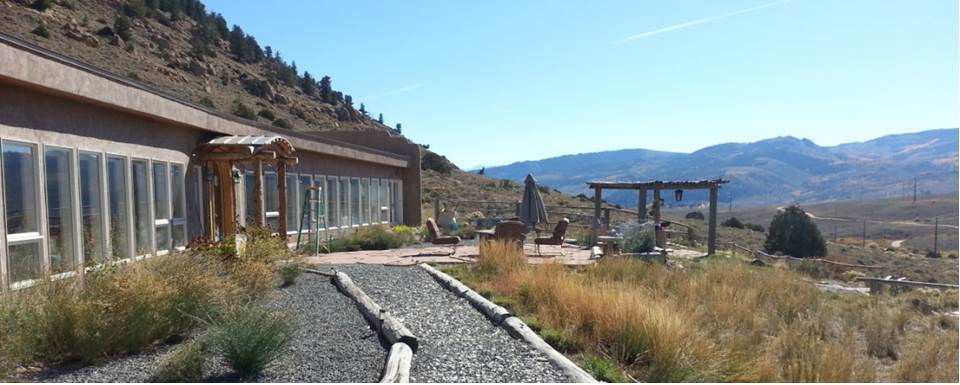
Welcome to the site that documents our tire bale house project outside of Granby, Colorado. We call it the "House of the Holey Rocks." Our tire bale project began about six years ago when we started planning our house. Our excavation started in the fall of 2004. Our web site went live in 2005/2006. If you'd like to skip over much of the imagery and see a "beginning-middle-part," go to the bottom of each page and follow the links on the bottom left. Come back often as the final tasks of putting together the interior of the house progresses. 2010 Updates Here is an exterior view of our tire bale home before the snows fell this winter. January 2010--We entertained some friends from Australia over the Christmas holiday and even held an open house. What FUN! So far everyone loves the house! The most common saying is "your house is so-o-o-o quiet". Laura has found that she must "squeegee" the windows each morning due to the sheer amount of humidity the house holds (above 35% most days) and the condensation that collects on the windows at night when it is cold outside. We are still living with blue styrofoam as window coverings for the east end windows and that doesn't help. It seems that anything that is a cloth window covering doesn't seem to allow as much condensation on the window. As the water runs down, it is washing the clay off the lower wall, which is disturbing. We'll have to find a remedy for this. Please checkout the thermo images of our home taken by a guy from our local utility company (see links below) and then visit our blog for the discussion on these. Visit our BLOG and leave some comments. We have been hearing of more tire bale homes under construction and are very glad to hear this. If you have a tire bale home being designed or under construction, please let us know via email. 2009 Updates December 2009 -- We have lived in our home for a whole year now and it has performed beautifully in rain, sleet, bitter cold, as well as in the sunshine. During the winter, if we get at least 4 hours of sun per day, the inside stays above 60-degrees. We do have some issues with some water lines freezing whenever outside temperatures drop below 5-degrees (F). The mountain plumber ran these in the ceiling(!) near the kitchen, which is also near a roof cap. It actually isn't the lines freezing--they're the new flexible pvc. It is the brass fittings that freeze. We are working on remedies to this. Our local utility company sent a representative out to do an energy audit in the fall. We learned a few things from him. We should not leave our heavy equipment plugged in all the time nor the heat tape on some of our water pipes as these are energy drainers. Also, since our east end is now enclosed, our electric bills should be much lower for 2 reasons: 1) the heaters will be off much of the time and; 2) Last winter with the east end not enclosed completely, all the heat from the west end was being sucked right out so our energy bills were pretty high. Laura is investigating how much installing some solar panels will set us back, as well as a wind generator. Well, this is a grand experiment for us. The guy who did our energy audit came back in late Dec. to take some thermo infrared images of our home. I hope you'll study these carefully as we would like to get some dialogue going about what these images illustrate about this kind of home. Thermo image1 Thermo image2 Thermo image3 Thermo image4. We are at a complete standstill on getting a mortgage. No comps, no appraisal, no loan. sigh.... Does anyone know a banker or someone who will make us a loan? April 1, 2009--Here is a Powerpoint file that shows what our place looks like inside. We're quite proud of our home. This presentation will open in a new window, then you can press the page down key to step through the 3 pages. Ours is the first tire bale home construction to be completed and occupied. The house has been warm through the winter months--on sunny days, it gets as high as 84 degrees--even hotter when sitting directly in the sunshine. At night the temperatures hang around 60 degrees without a fire going in the wood stove and 70-74 degrees with a fire going--when outside temperatures are above 10 degrees. We have noticed that when outside temperatures dip under 10 degrees or go sub-zero, we have to really boost the heat in the house either by a constant rip-roaring fire and/or using the baseboard heaters. Fortunately, we have had a mild winter. You see, it takes about 3 years for the thermal mass to completely "heat up" and we're just now coming into the third year. The most notable difference in the temperature of the house seems to be how much sun we get during the day and are the window coverings closed as quickly as possible when the sun sets or when the sun goes behind clouds for too long. We had been living with blue 1-inch styrofoam in the windows to keep our heat inside until February. The first round of motorized triple-cell blinds were installed the second week of February and with these, we really noticed how well the house holds heat! Nearly every sunny day is t-shirt and shorts weather inside of our home. We can hardly wait to get the blinds installed into the east end of the house! We have watched the sun move more northerly in the sky as well as how that affects changes in the heating of our home. In January and February, the sun came into the house as far back as the height of the tire bale walls (20+ feet back and about 10-feet high). Now, in April, the sun only comes into the house about 2-feet back. We have seen no signs of structural stress although we have seen signs of settling. Nothing serious though. We have been working with a couple of teams of students from the Colorado School of Mines EPICS program on studies of the house. We hope to see some materials from this work soon. We have become a part of the economic downturn in that since our home is so unique, we cannot secure a mortgage, which would allow us to purchase and install solar panels and complete the front courtyard. No lending institutions wish to be a part of this "new" technology--even though this technology has been around for many years. No comps--no loan. Hopefully, more tire bale homes will be completed this year! Many people have contacted us asking how they too can build a house like this one. For most questions, we refer people to our designer Michael Shealy--Touch the Earth Construction. We have also setup a blog to aid in getting answers for people. Our blog address is https://hagartirebales.wordpress.com. Stop by sometime. February 2009 -- We lost our engineer, Leonard Jones, to a sudden heart attack on Valentine's Day. Our thoughts and prayers go out to his family and friends. We will miss his dedication and further contributions to our project. December 2008 -- WE DID IT! We completed the final inspections this past week and now we can actually move into our tire bale home. We got what we wanted for Christmas--our new home. We hope you got what you wanted too. Please take a few moments to review Gallery page 5 for the final pictures of putting the house together. We send a BIG THANK YOU to friends and fellow workers who have helped us along this long journey. Please visit each of our Gallery Pages (1 through 5) to see how our house came together. June2008 -- My oh my, but summer is here and it is HOT in Denver but cool in the mountains. It finally stopped snowing in June. Fortunately for us, we were working inside most of the time. Jeffery worked outside a bit adding our new front porch. Don't you think it adds a bit of charm to the "industrial shopping mall" look? Jeffery is using all pine beetle killed trees for this. The cattle drives have started from the local ranches. Bet you can't say you see this sort of thing in the city--cows, cowboys and cowgirls in your driveway. After working with Elite Cabinetry and Granite in Denver for over a year (Thanks for your patience Gary Fielder), our granite was finally installed in the kitchen. It certainly adds a touch of class to the house. The plumber installed the kitchen faucet shortly thereafter. Friend Art Wilson still continues to work with us. I guess it keeps him young. Here he and Duncan enjoy taping and mudding the drywall. Mike Kunzman, American Clay in Denver, came up and showed us how to apply clay to the tire bale walls. We decided to cover the drywalled walls and the ceiling in the great room in clay. Our first task is to apply clay to the master bedroom. There are many interesting stories about clay, applying clay, and living in structures made with or covered in clay. Hopefully I'll get time to put some of those up. Mike also showed us the techniques of blending colors as well as making finger patterns in the clay. Thanks Mike. Duncan and I arrived at the site one morning to find a winged visitor inside. We are happy to report that even though she was a bit stunned from hitting a window and then being picked up by a human and then released, she flew off about 5 minutes later after regaining her composure and having many long astounding looks at us. Here is another look at our experimental house from a distance. Would you like to know how to build a tire bale house? Our designer, Michael Shealy has put together a pictorial sequence to help answer some questions and to help others understand the sequence of building a tire bale house. We're also strating to work on a book. Check back later for an expected publish date. May 2008 -- What happened to the beginning of 2008? We made slow progress on the interior due to a good ski season. Skip over to Gallery page 4 for the very latest images. January 2008 -- Progress continues on the inside of our tire bale house in spite of gale force winds blowing mound after mound of snow across our road. Take a look at Gallery Page 3 for more images from the inside and out. 2007 Updates It is already November 2007, and Laura has been trying to stay on top of all of the latest updates to our website! She has added many new images and stories, so now there is a Gallery Page 3. Some of you have reported problems seeing the movies and some of the images from the other galleries. She is still working to correct those issues. (Laura works with software all day and the house on weekends, and isn't thrilled to work with web sites in the evenings and weekends. So, please be patient.) Are you interested in learning about what it takes to build a tire bale house? If so, please drop an email to Jon & Laura Hagar at our email address below. Our original plans for a workshop in spring 2007 did not materialize. Fate had other plans for us in the early months of 2007. We were very busy building the house, keeping the roads clear of snow during a hard, snowy winter, plus we have been working our "day" jobs. Project Summary We were looking for an easier building technique to the rammed earth tire (earthship) home as well as an alternative to the traditional stick house. We researched earthship and straw bale techniques and originally wanted to go with the earthship technique, but one of us did NOT want to do all of the work of ramming dirt into so many tires! Ta-Dah, tire bales! Thanks to the help of our patient realtor (Jim Glenn in Granby, CO), we found a great piece of property surrounded by thousands of acres of public lands. We'll have very few neighbors, but more importantl--no covenants. Our house is similar to the "earthship" concept created by Michael Reynolds (formerly www.earthship.org) but with a few changes, some of which use conventional building techniques. We
really liked the idea of using tires, cans, and bottles to build with and
using solar energy for electricity and warmth, but physically pounding
dirt into so many tires--NO WAY! A tire
bale is a "big square brick" of about 100 compressed whole tires. Each bale
is approximately 5 feet deep by 5 feet wide by 2.5 ft. high and weighs
about 2,000 lbs. (1 ton). A tire bale (by iteself) has an energy rating of somewhere between R-40 and R-200 depending on which study you read and how it's used. The tire bales are encased in concrete, effectively making the tire bale walls of our house about 6-feet thick. |
|
|
|
||
|
Our house uses approximately 170 full bales and about 5 half bales or about 17,000 tires. Tire bales are FREE--as long as one presents a bulding permit. All we had to do was get the bales hauled from Sedalia to Granby Colorado, a distance of about 135 miles. The tire bales are stacked like bricks to make up all of the outer walls. These walls form the structural integrity of the house. Shot-crete (sprayed on concrete) is applied to finish the walls, effectively creating a minimum 6-foot thick wall. The entire south of our house is glass--windows and doors. This creates a large, active thermal mass, which should maintain a relatively constant temperature of 65-degrees. Imagine the energy savings! Tire bales are not that new. They have been used for quite some time for building barns, holding river banks, and road construction. Using them for house construction is a fantastic and practical idea whose time has come. We decided to hire a contractor initially to help us construct our dream home since we both are workaholics. We carefully chose Larson & McKnight Construction in Tabernash, CO. They have been flexible and innovative working with the experimental technologies of tire bales, which is what you need when working with contractors and this sort of technology. For more information on the tire bales and how they are made, visit Michael Shealy's web site or Front Range Tire Recycling's web site. Michael Shealy also has some great links to other sites you may wish to visit from his site. One of the most important is Leonard Jones, P.E. site. Leonard's pdf file on building with tire bales contains much of what you'll need to know for an undertaking of this kind. Both Michael and Leonard have been of great assistance to us on our project. Visit our Gallery Pages for updated pictures. We will add more pages as our story progresses. _____________________________ Please remember that our site will be constantly under construction and updated as the building progresses, but if you have specific questions regarding building with tire bales, just email us. | ||
email us: invision at ecentral.com
(NOTE:You'll have to construct our address in your individual email program by substituting "at" for @ sign. We leave our address this way to weed out the robots that collect email addresses from web sites.)